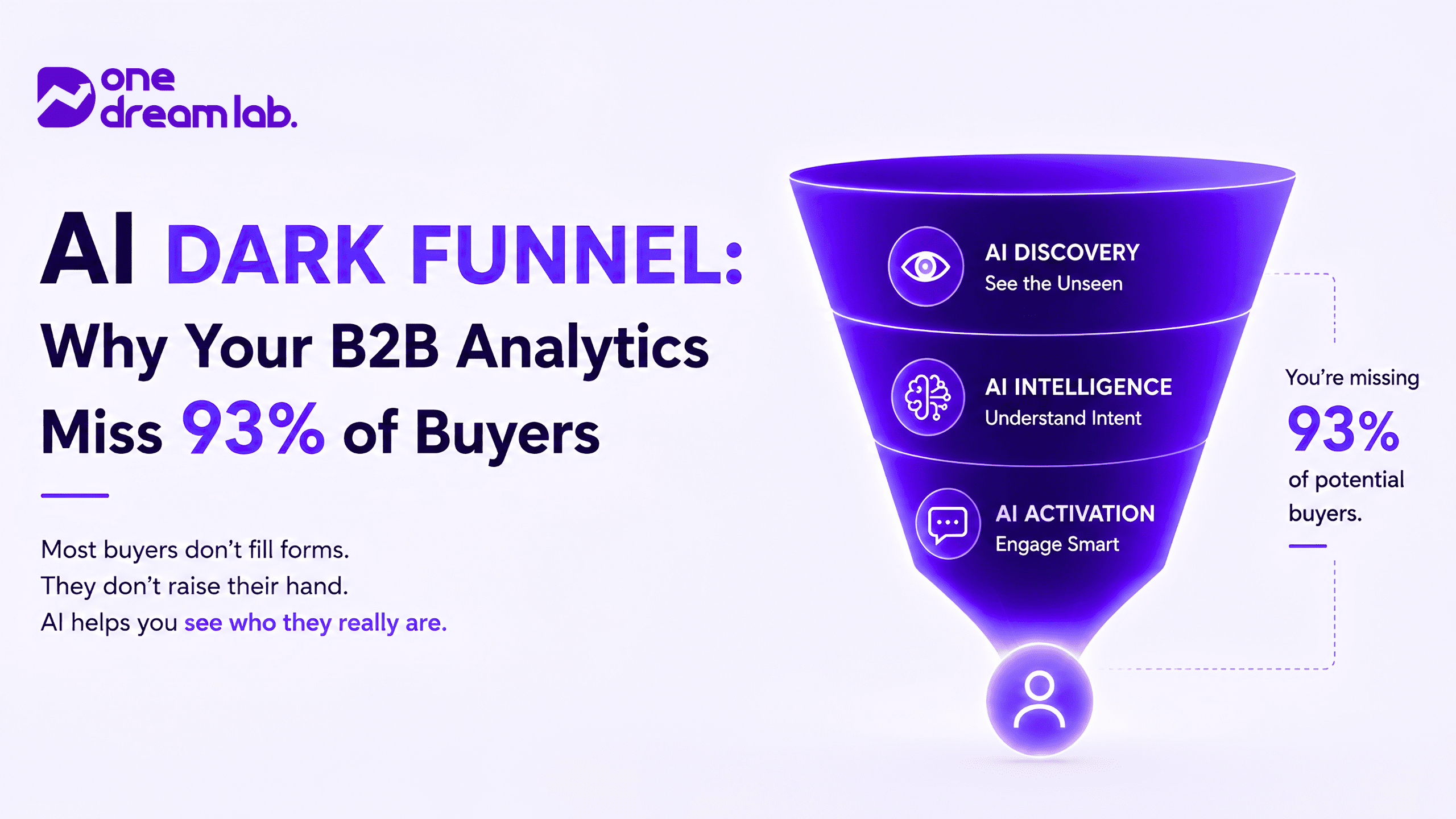
The AI dark funnel is eating your pipeline data alive, and most B2B marketing teams have no idea it’s happening. Buyers use ChatGPT, Perplexity, and Gemini to research vendors, compare pricing, and shortlist options without ever clicking a link. Your analytics dashboard shows a quiet Tuesday. Meanwhile, a procurement team at a $50M company just decided you’re not on their list.
That’s the new reality, and it’s worse than most people think.
The AI dark funnel is bigger than “dark social” ever was
The dark funnel has existed for years: Slack conversations, podcast recommendations, word of mouth over lunch. Marketers have complained about it forever. This current wave is different in kind. AI-powered search doesn’t just hide attribution, it removes the mechanism for attribution to exist at all.
When someone searches Google, they might not click your result, but the impression still registers. When someone asks ChatGPT “what’s the best contract management software for a 200-person law firm,” nothing registers. No impression, no session, no referral. The answer either includes you or it doesn’t, and you’ll never know which.
In 2026, an estimated 94% of B2B buyers use LLMs during their procurement process. That isn’t niche behavior. It’s the default research mode for a generation of buyers who grew up Googling everything and now find Google too slow.
Why last-touch attribution is failing B2B teams right now
Last-touch attribution was a bad model before AI search existed. Giving 100% of revenue credit to the final touchpoint, usually a demo request or form fill, ignores every piece of content, every ad impression, and every community post that actually built the preference.
At least with last-touch attribution, you could see something. You had a click to attribute. You had a session to track. Now 93% of AI search sessions end without a single website visit, according to the research behind this topic. Last-touch doesn’t fail gracefully in that world. It fails completely.
Here’s the scenario playing out in B2B companies right now. Traffic is flat or slightly down, conversion rate looks fine, but pipeline is either quietly building or quietly collapsing, and nobody can tell which until the quarter ends. The lag between AI-driven discovery and an actual CRM entry can run 60 to 90 days. By the time the data shows up, the chance to course-correct is gone.
67% of B2B teams still run last-touch attribution as their primary model. That number is a problem.
The invisible buyer journey: what happens before your CRM sees them
Picture a modern B2B buying journey for, say, a VP of Finance evaluating expense management tools. She doesn’t Google “expense management software.” She opens ChatGPT and types a natural-language question about what mid-market companies use for expense tracking. She gets a list, maybe Brex, Ramp, Coupa, with short explanations.
She follows up: “Compare Brex and Ramp for a company with 150 employees.” Another clean answer. Maybe a third question: “What are the main complaints about Ramp from finance teams?”
At no point in this invisible buyer journey does Brex or Ramp see a single pixel fire. If Ramp’s product has a real weakness in Trustpilot reviews or Reddit threads, and those sources fed the LLM’s training, that answer just shaped her opinion permanently. Her first visit to Ramp’s website is to book a demo. Last-touch attribution says Ramp’s homepage converted her. It did almost nothing.
The actual influence happened in channels no one measured.
Dark funnel analytics: what you can actually track
Here’s the uncomfortable truth: you can’t fully measure the AI dark funnel. Anyone selling you a “complete solution” to this problem is oversimplifying.
What you can do is build a hybrid measurement approach that captures signals you’ve been ignoring. Platforms like 6sense and Demandbase track anonymous company-level intent data, telling you which companies are researching keywords tied to your category, even without a visit. HockeyStack and DreamData go further and correlate ad impressions, content consumption, and sales activity across the full journey.
Self-reported attribution is underrated. Ask prospects during discovery calls: “How did you first hear about us?” The answers are often humbling. “My co-founder mentioned you in a Slack message.” “I saw your name in a ChatGPT answer two months ago.” Logged consistently in your CRM, that qualitative signal builds a clearer picture of what’s driving awareness.
Then there’s share of voice in AI answers. New tools, some built on top of the same LLM APIs, let you prompt ChatGPT, Claude, and Gemini with your category’s typical buying questions and see where, or whether, you show up. It isn’t perfect measurement, but it’s directionally useful, and you can do it today.
“The companies winning in AI search aren’t gaming the algorithm. They’re becoming the answer, through original research, strong community presence, and product reputation that earns mentions whether or not anyone is tracking them.”
AI search marketing: how to get mentioned when nobody’s clicking
Getting into AI answers isn’t about keyword density in your blog posts. LLMs synthesize from a much broader surface: Reddit discussions, G2 reviews, Trustpilot, Hacker News threads, LinkedIn posts from practitioners, academic papers, and high-authority editorial content.
Three things actually move the needle on AI search marketing.
Original data and research. ChatGPT cites numbers. If your company publishes a genuine benchmark report, not a content-marketing fluff piece but an actual survey with a real methodology, it gets referenced. Salesforce’s State of Sales report, Gartner’s annual surveys, and HubSpot’s State of Marketing show up in LLM answers because they’re credible primary sources with specific figures.
Community presence. What your customers say about you on Reddit, in Slack communities, and on G2 matters more now than it ever did for SEO. LLMs train on public forums. A product that earns genuinely positive word of mouth in r/sales or r/devops is a product that gets mentioned in answers.
Third-party editorial coverage. A mention in a TechCrunch piece, a Forrester report, or even a solid niche newsletter carries weight in ways that self-published content doesn’t.
Your owned blog still matters, just not the same way. It’s table stakes for credibility, not a primary distribution channel for AI-native buyers.
What to do with your attribution model starting this quarter
You’re not going to fix attribution in a week. Here’s a practical starting point.
First, add a self-reported field to every inbound form and to your sales team’s discovery call template. Ask where they heard about you. Even inconsistent data beats none.
Second, audit your presence in AI answers for your top 10 buying questions. Do it manually, right now, using ChatGPT and Perplexity. Find the gaps. Then identify which third-party sources, whether review sites, communities, or editorial outlets, could realistically move you into those answers.
Third, stop optimizing purely for last-touch conversion rates. Start tracking pipeline by cohort, including early-stage signals from intent platforms. If a company showed up as a high-intent account in 6sense three months before they booked a demo, that signal was doing work even if your attribution model never captured it.
The shift in thinking comes down to this: marketing success in 2026 means getting into the consideration set before anyone shows up on your website. The website visit is almost a formality by that point. Everything that shaped the decision happened earlier, in conversations, AI answers, and communities your analytics never touched.
Frequently Asked Questions
What is the AI dark funnel?
The AI dark funnel is the part of the B2B buying journey that happens inside AI-powered tools like ChatGPT, Perplexity, and Gemini: research sessions that generate no trackable clicks, sessions, or referral data. Buyers discover, evaluate, and shortlist vendors entirely within these tools, leaving no footprint in traditional marketing analytics.
Why is last-touch attribution a problem for B2B marketing in 2026?
Last-touch attribution credits the final interaction before a conversion, typically a demo request or form fill, with 100% of revenue influence. When most of a buyer’s research happens in AI tools that generate zero clickable events, last-touch data captures only the very end of a journey that started weeks or months earlier. Teams using it are optimizing for the wrong signals.
Can I track what happens in AI search sessions?
Not directly. ChatGPT, Perplexity, and Gemini don’t expose session data to third parties. But you can get directional signal through self-reported attribution (asking prospects how they heard about you), intent data platforms that track company-level research behavior, and manual audits of AI answers for your category’s key buying questions.
How do I get my brand mentioned in AI search answers?
Focus on the sources LLMs pull from: G2 and Trustpilot reviews, Reddit and Hacker News discussions, high-authority editorial coverage, and original research with real data. Keyword-optimized blog posts are table stakes, but they alone won’t get you into AI answers. Community reputation and third-party credibility matter more.
How long is the average B2B buying journey now?
Research from 2025 puts the average B2B buying journey at 211 days across 76 touchpoints. The AI dark funnel stretches this further, because more of those touchpoints now happen in invisible channels. The gap between a buyer’s first AI-assisted research session and a CRM entry can easily run 60 to 90 days.

Written by
Bharath VodapallyBharath Vodapally is co-founder of OneDreamLab. He writes about SEO, AI search, paid media, social and growth, drawing on the campaigns the team runs for brands every day. He turns what actually works in the field into practical playbooks you can use.
Comments
Loading comments…