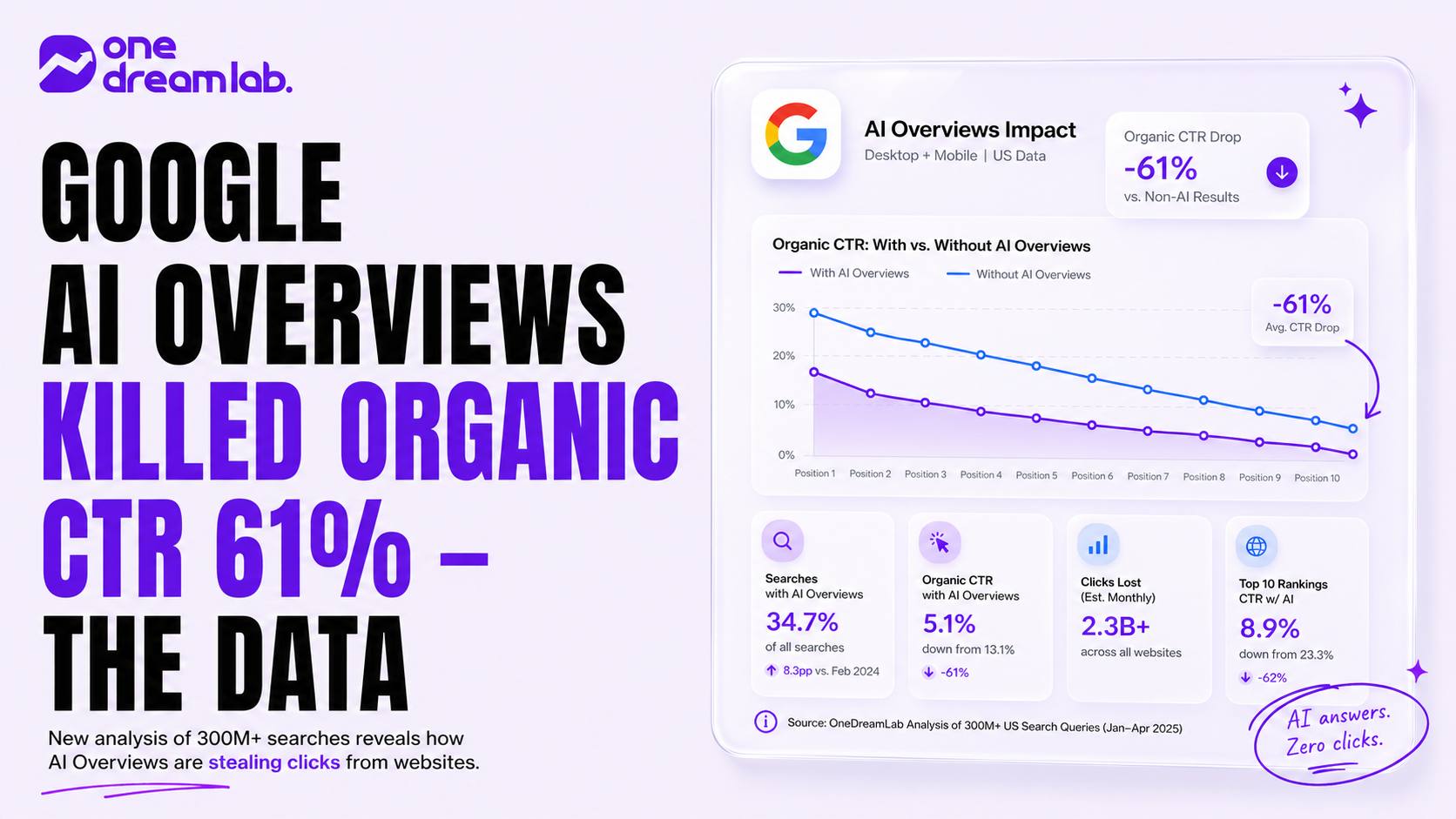
Google AI Overviews are killing organic CTR, and the numbers have stopped reading like a warning. They read like a verdict.
Seer Interactive tracked 3,119 informational queries across 42 organizations and 25.1 million organic impressions from June 2024 to September 2025. When a Google AI Overview appeared on the page, organic click-through rates dropped from 1.76% to 0.61%. That is a 61% collapse, and it looks less like a seasonal dip than a structural change in how search works.
What the Google AI Overviews CTR drop actually shows
The Seer study is the most rigorous analysis on this question so far, and if you run an SEO-dependent business, its findings should worry you.
The 61% organic CTR drop is the headline number. The detail that really stings is this: even queries without an AI Overview saw organic CTR fall 41% over the same period. Google’s shift toward answering on the page is repricing every position in the SERP, not just the ones where an AI Overview lands above the fold. AI answers are changing how people use results pages even when no AI Overview actually appears.
Paid search did not escape either. Paid CTR on AI Overview queries dropped 68%, which is more than organic. That is the counterintuitive finding most coverage buries, and it matters: if advertisers are losing clicks when AI Overviews appear, the old logic of “I’ll just buy traffic around this” starts breaking down.
So Google answers the question, the user reads it, and nobody clicks. That is the loop, and it is working exactly as designed.
The HubSpot search traffic collapse: what the real numbers look like
HubSpot is the clearest large-scale example anyone can point to, partly because CEO Yamini Rangan talked about it openly on an earnings call instead of burying it in a footnote.
Between November and December 2024, HubSpot’s organic traffic fell from 13.5 million monthly visits to 8.6 million. That is nearly 5 million visits gone in 30 days. By Q2 2025, the company had shed somewhere between 70% and 80% of its organic search traffic from peak. On that Q1 2025 earnings call, Rangan told analysts directly: “AI Overviews are giving answers, and fewer people are clicking through to websites.” No spin. She named the mechanism.
Here is what is easy to miss: HubSpot’s rankings did not collapse. Their positions held. The traffic disappeared anyway because Google was answering above the fold before users had any reason to scroll down to the actual results.
Position one no longer means what it used to mean. You can own the top result and still lose the visit.
This is the new math of organic search. It is no longer about ranking. It is about whether Google decides your topic gets an AI Overview, and whether you are cited inside it when it does.
Zero-click search impact: why this isn’t a fringe effect
The phrase “zero-click search” has been floating around SEO circles since at least 2019. For years it felt like a slow-moving trend, something worth monitoring but not urgent. It is not slow anymore.
Ahrefs published an updated study in February 2026 tracking 300,000 keywords. The finding: CTR at position one drops 58% when an AI Overview is present. That lines up closely with Seer’s 61% figure, across a completely different methodology and dataset. When two independent studies land in the same ballpark, you cannot wave it off as sampling error or a methodology artifact.
The industry-wide signal matches. The median publisher saw a 10% year-over-year organic traffic decline in the first half of 2025. Non-news content sites dropped 14%. Those are averages, which means plenty of publishers fell considerably harder.
Then there is the consumer response. DuckDuckGo reported a 30% surge in app installs and a 28% jump in site visits in the single week following Google I/O 2026. That spike did not happen because millions of people suddenly cared about privacy philosophy. It happened because ordinary users opened Google, got an AI-generated answer they did not fully trust, and went looking for an alternative. It is a measurable behavioral signal. Small relative to Google’s total volume, but directional.
Why SERP feature optimization is now table stakes
One finding in the Seer data that most coverage glossed over: brands cited inside AI Overviews earn 35% more organic clicks and 91% more paid clicks compared to brands not cited.
That is worth sitting with. Being cited in the overview that is supposedly killing your traffic actually lifts your traffic, and by a lot.
So the new SEO game is not “rank in position one.” It is “earn a citation in the AI Overview.” Those are completely different tasks. Citation optimization means writing content built to be excerpted: clear definitions, direct answers to specific questions in the first two sentences under each heading, citable statistics with clear sourcing, and structured data markup that tells Google’s systems the content is authoritative and easy to extract.
There is a real tension in that approach, and it is worth naming honestly. You are optimizing to appear inside a feature that aggregates your content and reduces the need to visit your site. But the alternative, ignoring AI Overview optimization entirely, means your competitors earn the citation and the 35% traffic lift while you earn nothing. The imperfect play beats the passive one.
The DuckDuckGo surge and what user behavior actually signals
The DuckDuckGo install spike is worth pausing on because it reveals something about user psychology that SEO analysis usually ignores.
A 30% jump in weekly installs is not a privacy-advocacy story. It is an experience story. People opened Google, got an AI-generated block of text in response to a question they cared about, and felt something was off. Maybe the answer was too generic, maybe it was too confident about something uncertain, maybe it just was not what they came for. So they went somewhere else. That is the signal underneath the DuckDuckGo number.
I would push back, though, on reading this as a durable competitive shift away from Google. The distribution reality is brutal. Google is the default on virtually every Android device sold globally, and it is the default in Safari on iPhone. Most users never change defaults. The real competitive pressure on Google right now is not DuckDuckGo or Bing. It is AI chatbots. ChatGPT with web search, Perplexity, and similar tools all target the same informational queries that AI Overviews handle, and those products have the novelty, the interface, and the direct-answer experience that users seem to want.
Google may be losing to itself. AI Mode cannibalizes AI Overviews, which cannibalize organic results, and the whole stack reduces the number of outbound links users follow in any given session.
How to adapt your SEO strategy right now
Adapting to organic CTR loss from AI Overviews means rethinking what successful content actually is. A few specific approaches that are showing traction:
- Target long-tail queries too specific for AI Overviews to answer cleanly. Overviews handle broad informational questions well. Highly situational queries, the ones involving specific numbers, uncommon product combinations, or niche comparisons, are far less likely to trigger an AI Overview at all.
- Restructure existing pages for citation. Use tight H2 definitions. Answer the question directly in the first sentence under each heading. Produce original data Google can reference rather than answer from scratch. If Google is going to excerpt your content, make the excerpt strong enough to pull a curiosity click.
- Audit your AI Overview exposure. Tools including Semrush and Ahrefs now flag SERP features at the query level. Find out which of your high-traffic pages are sitting below an AI Overview and treat those as your first restructuring priority.
- Build owned channels in parallel. Organic search as top-of-funnel acquisition is structurally weaker than it was in 2022. Email lists, newsletters, and community channels are less exposed to SERP feature volatility. Companies that spent 2023 and 2024 building those assets are in a far more stable position than businesses that ran purely on SEO volume.
February 2026 data showed a slight organic CTR rebound on AI Overview queries, from 1.3% in December 2025 to 2.4% in February 2026. That is mildly encouraging. But 2.4% against a mid-2024 baseline of 1.76% suggests the floor shifted permanently rather than temporarily. Anyone treating that rebound as a reason to stand pat is reading the wrong chart.
The search traffic collapse from Google AI Overviews is real. Organic CTR fell 61% across 25 million impressions in the Seer study. Ahrefs confirmed the scale independently. HubSpot lost 70% of its organic traffic with its rankings intact. The mechanism is no mystery: Google answers before anyone clicks. The content teams that restructure for citations and diversify their channels in 2026 are the ones that will have stable audience relationships by 2027.
Frequently asked questions
How much does organic CTR drop when a Google AI Overview appears?
Seer Interactive’s study of 3,119 informational queries found organic CTR drops from 1.76% to 0.61% when a Google AI Overview is present, a 61% reduction. Ahrefs independently measured a 58% drop at position one in a February 2026 study of 300,000 keywords, closely corroborating Seer’s findings.
Did HubSpot really lose most of its organic traffic to AI Overviews?
Yes. HubSpot lost roughly 70 to 80% of its organic search traffic between late 2024 and Q2 2025. Their rankings stayed largely intact. The traffic vanished because Google AI Overviews were answering questions before users needed to click through. CEO Yamini Rangan confirmed the cause on a Q1 2025 earnings call.
Can you still get traffic if you’re cited in a Google AI Overview?
Yes, and the uplift is significant. Seer’s data shows that brands cited inside AI Overviews earn 35% more organic clicks and 91% more paid clicks versus brands that appear in the SERP but are not cited. Being cited inside the overview is now more valuable than holding the top organic position below it.
What types of content are less affected by AI Overview CTR drops?
Long-tail queries with high specificity, such as niche comparisons, precise technical questions, or queries involving specific numbers or product configurations, are less likely to trigger an AI Overview. Original research, proprietary data, and content structured with direct H2 answers also tend to earn citations rather than getting bypassed.
Is the organic CTR drop from AI Overviews permanent?
The trend so far points to a structural floor shift rather than a temporary dip. Organic CTR on AI Overview queries briefly rebounded to 2.4% in February 2026 after hitting 1.3% in December 2025, but the mid-2024 baseline was 1.76%. The floor moved down even during recovery phases, which suggests a lasting recalibration of search click behavior.

Written by
Bharath VodapallyBharath Vodapally is co-founder of OneDreamLab. He writes about SEO, AI search, paid media, social and growth, drawing on the campaigns the team runs for brands every day. He turns what actually works in the field into practical playbooks you can use.

Comments
Loading comments…