
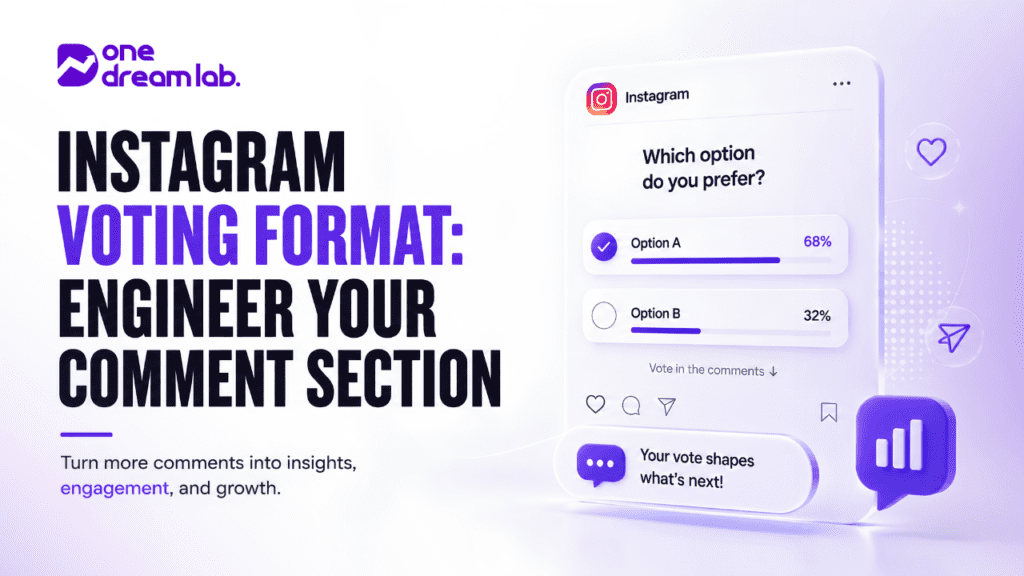
The Instagram voting format is one of the few content tricks right now that does two things simultaneously: it drives comment section engagement and quietly tells you what your audience actually wants to see from you. Not through a survey. Not through analytics. Through a Reel that people genuinely want to participate in.
Here’s the format: you put a polished, high-effort edit back to back with a simple, raw static shot or minimal take in the same video, then ask your audience to vote in the comments on which one they like better. That’s it. No complicated setup. No third-party tool. Business accounts can run it today, without any special access or paid features.
How the Instagram Voting Format Works (And Why It’s Spreading)
The format surfaced in the Newengen May 2026 Instagram trends report with a viral score that put it well above most format trends tracked that month. The core mechanic is a head-to-head comparison — polished versus casual, studio shot versus iPhone grab, edited audio versus raw cut — and the call-to-action is explicit: “comment 1 for the edit, comment 2 for the raw one.”
Comments flood in because the action is low friction and binary. People love picking sides. You’re not asking them to write a paragraph of feedback. You’re asking them to type a number.
That specificity is what makes it work algorithmically — and what makes it actually enjoyable to engage with.
Why the Instagram Algorithm Rewards This Format
Instagram’s algorithm in 2026 weights comment volume and share rate harder than it did two years ago. According to Buffer’s updated guide on how the algorithm ranks content, early engagement — especially comments in the first hour — tells the system this post is worth distributing further. A voting format is almost purpose-built to generate that early comment rush.
But there’s something subtler happening. When your audience debates in the thread — “definitely 1, the lighting is way better” or “no, 2 feels more authentic” — those are qualitative, conversational comments. Instagram treats that back-and-forth as a positive signal, not just a raw comment count.
The algorithm doesn’t just count comments. It reads the room. A debate about your content in the comment section is one of the best organic signals you can send the system.
So: the voting prompt generates initial comments. Those comments generate replies. Replies push notifications back to the original commenters, pulling them back into the thread. The engagement compounds without you having to do anything else after publishing.
Comment Section Engagement Is Something You Can Actually Engineer
Most accounts treat the comment section as a passive outcome — something that happens to their post. The voting format flips that entirely. You’re designing the comment section before you publish.
This matters because Instagram’s native comment polls (which were added as a feature in 2025 and let you pin an interactive question at the top of the thread) surface to people who haven’t engaged yet. They see a live poll with real-time results, and the social proof of 300 people having already voted makes them want to weigh in too. That pull is hard to manufacture with a generic “thoughts?” caption.
A few things that make the format land in practice:
- The comparison has to be genuine. If both options look equally polished, nobody cares. The gap between “high effort” and “raw” needs to be visible at a glance. Stage a fake “bad” version and the audience will feel it.
- Your caption anchors the stakes. Something like “I spent 3 hours on the left edit. The right one took 6 minutes on my phone. You tell me which one you’d actually stop scrolling for” gets people invested because you’ve made yourself vulnerable to the answer.
- Pin a comment immediately after publishing. This restates the vote options, keeps latecomers oriented, and adds to your own comment count before anyone else has shown up.
Instagram Reels Audience Voting as Content Market Research
Here’s the part most creators are sleeping on: the vote results are data.
If 70% of your audience picks the raw iPhone shot over the polished edit, that’s not just a fun result. That’s your audience telling you to stop over-producing. It’s the kind of signal that used to take a formal survey or weeks of A/B testing to surface. Now you get it in 48 hours, in your comment section, from the exact people who follow you.
For founders and small agencies, this is particularly useful. Say you’re a DTC skincare brand choosing between polished product photography and founder-led, talking-head content. Run the voting format with one real example of each. The comments will tell you more than any focus group.
One brand doing this well is a supplement founder who posted a studio-lit product flat lay against a gym-bag grab shot, asked comments to vote, and pulled 600+ comments in 48 hours. The raw shot won by a wide margin. They’ve leaned into that aesthetic ever since, and their saves per post went up noticeably. Sometimes the market research is just: stop trying so hard.
And frankly — the fact that you can get this kind of qualitative feedback for free, on a platform you’re already using, is a reason to be skeptical of anyone charging you for “content strategy consulting” before you’ve run a single voting Reel.
Why Business Account Instagram Engagement Is Hardest to Crack (And Why This Format Helps)
Business accounts have historically gotten fewer algorithmic breaks on Instagram. Meta’s own guidance acknowledges the platform tends to suppress overtly promotional content. The voting format sidesteps that.
It’s not promotional. It’s participatory. The subject of the vote can be your product, but the post itself is framed as a community question, not a pitch. That distinction matters to both the algorithm and the real human watching it.
And unlike a lot of engagement bait — “tag someone who needs this” — the voting format delivers genuine value to the audience. They get to influence your content direction. They’re consulted, not just marketed to. That’s a trade worth making.
Business account Instagram engagement is hardest to crack because most of the playbook for creators doesn’t translate cleanly. This format is one of the real exceptions. Run it under a creator account if you have one, but it works under a business account too.
How to Set Up Your First Voting Reel
You don’t need anything fancy. The format is deliberately accessible.
- Pick two real pieces of content that represent genuinely different production levels. The contrast is the point — don’t manufacture a fake “bad” version.
- Edit them into a single Reel, ideally 15–30 seconds total. Sequence them clearly so viewers know which is A and which is B.
- Add on-screen text labeling each option (1 and 2, or A and B — keep it obvious, keep the font readable).
- Write a caption that explains what the two options are, asks for the vote, and adds enough context to make the choice feel personal. Why did you make both? What were you trying to achieve with each?
- Pin a comment immediately after publishing that restates the question and the options.
- Reply to the first 20 comments within the first hour. This seeds the thread and notifies those early voters to come back.
That’s the playbook. The format does most of the heavy lifting from there.
What the Comment Data Actually Tells You
The vote count is the obvious output. But there’s more signal in the comment section if you look past the numbers.
Read the comments that explain themselves. “Voted 1 because it looked more trustworthy” tells you something different than “voted 1 because the lighting was better.” “Voted 2 because the edit felt forced” is feedback no metric in your analytics dashboard can surface.
This is what makes Instagram content market research different from most forms of audience research — the qualitative reasoning shows up unprompted, in public, from real followers with no incentive to perform. Messier than a structured survey. But more honest.
Save a screenshot of the top explanatory comments. Look at the reasoning, not just the count. That reasoning is your next content brief — and it costs you one Reel.
FAQ
What is the Instagram voting format?
It’s a Reel structure where you show two versions of content — typically a high-production edit and a simpler, raw take — back to back in the same video, then ask your audience to vote in the comments on which they prefer. The format drives high comment volume quickly and serves as fast, qualitative market research for your content strategy. Business accounts can use it without any special setup.
Does the Instagram voting format work for business accounts?
Yes. Because the post is framed as a community question rather than promotional content, it tends to perform better organically than product-focused posts. Instagram’s algorithm rewards genuine comment engagement regardless of account type. The key is that the comparison feels honest — real creative effort on both sides, with a real question about which direction your audience wants.
How does comment section voting affect the Instagram algorithm?
Comments are a strong engagement signal, and the voting format is built to generate high early comment volume. Instagram’s 2026 algorithm treats early engagement — especially in the first hour — as a key distribution signal for Reels. The secondary effect is equally important: voting prompts replies and back-and-forth debate in the thread, which compounds engagement over 24–48 hours without any additional effort from you.
What kinds of businesses can use the Instagram voting format?
Any business that produces content in more than one style. DTC brands, agencies, coaches, restaurants, fitness studios — if you have two genuine approaches to content, you have the raw material for a voting Reel. The only requirement is that both options are real, not staged. Audiences can feel the difference, and a manufactured comparison falls flat.
How do I interpret the vote results for content strategy?
Don’t just count. Read the comments that explain why people voted the way they did. The qualitative reasoning in the thread is the real output — it tells you what to make more of, what your audience actually values, and what production choices signal authenticity versus effort. Treat the comment section as a free focus group and screenshot the most specific responses before they get buried.